





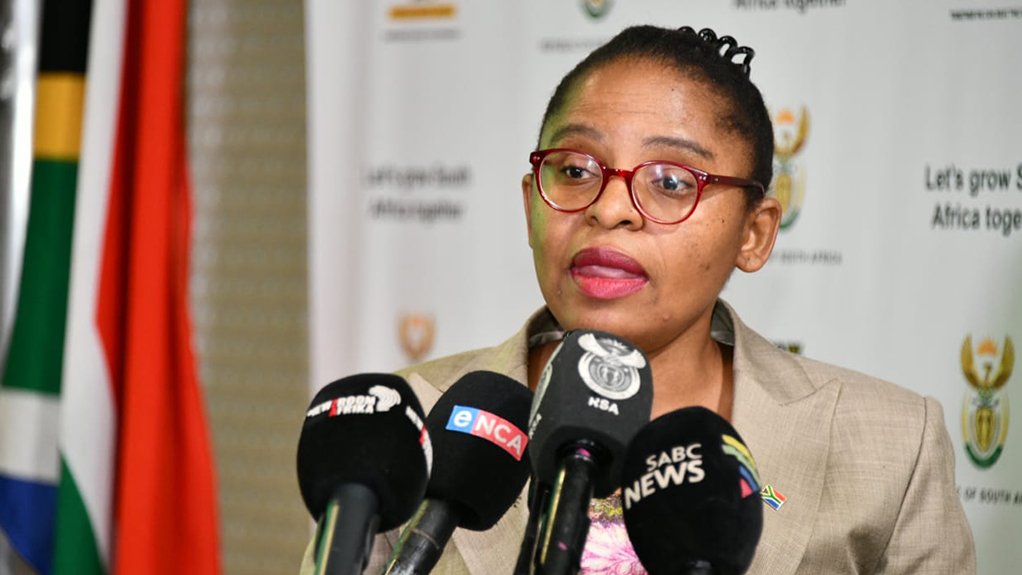
Secretary Sergei Shoigu of the Security Council of the Russian Federation, allow me to thank you for the successful organising and hosting of this 3rd International Security Forum.
High Ranking Officials responsible for Security Matters,
Ladies and Gentlemen
I have been listening carefully and attentively and agree with the sentiments already expressed on this matter of challenges and threats to international security in the emerging multipolar world.
The emergence of a multipolar world is reshaping the international security landscape. While the diffusion of power creates opportunities for greater inclusivity and regional influence, it also increases geopolitical rivalry, strategic uncertainty, and complex transnational threats. This diffusion has profound implications for international security, global governance, economic stability, and geopolitical competition.
The strategic competition between major powers has intensified global tensions. Resulting in major security risks such as proxy conflicts, militarisation of strategic regions, economic coercion, and sanctions, diplomatic polarisation, competition for influence in Africa, competition over resources, trade routes, and influence, and technological and cyber rivalry
This competition for influence in Africa has negative implications for the development of the African continent and African Union Agenda 2063, with similar implications for Africa and the developing world in general, to the ways the multipolar system of the 19th century did. The multipolar system of the 19th century resulted in colonialisation and slavery in Africa and the developing world, the consequences of which Africa is yet to recover from.
Today, the emerging multi-polar world system is seeking to balkanise the world, and South Africa is no exception. We are experiencing concerted efforts and campaign to portray the democratic government as anti-white with claims of “white genocide” that are disputed by facts, which the overall intention is to mobilise and justify the cessation of the Western Cape province to a whites-only enclave. This narrative undermines the core foundation of a democratic South Africa that is built on the principles of non-racialism, non-sexism, equal and a united nation. These principles were also the drivers of our struggle for liberation and freedom. This is part of a clear misinformation campaign against South Africa which is coordinated internationally.
Ladies and gentlemen,
The emergence of the renewed multipolar world is also weakening multilateral institutions. Institutions such as the United Nations and its agencies are increasingly struggling to resolve conflicts due to divisions among major powers, consequences of which include; paralysis in international decision-making, declining trust in international law, and reduced effectiveness of peacekeeping missions.
This situation has created difficulty in advancing African interests globally, it has reduced effectiveness of African peace and security mechanisms, and it is creating greater instability in conflict-prone African regions.
Global insecurity and insecurity within the African continent have strengthened transnational criminal and extremist networks, resulting in increased human trafficking, drug trafficking, illegal mining, arms smuggling, and terror financing. An undesired vicious circle. Worst is that these criminal networks threaten governance, economic stability, and public safety.
Increasingly, multipolar competition is also revolving around technology and strategic industries with resultant cyber warfares, digital espionage, and disinformation campaigns. There is a rise in cyberattacks on state infrastructure, data breaches and espionage, and manipulation through social media. These have created huge risks to financial and communication systems.
In response, South Africa is modernising its security framework to ensure we are capable of addressing these hybrid threats, with priority given to cybersecurity capability, border security, counter-organised crime operations, and protection of critical infrastructure. To respond to the technological posture of the emerging multipolar system, South Africa is seeking to develop digital sovereignty and investing in AI and cybersecurity. We have intensified our protection of strategic industries, enhancing energy security, and diversifying trade and investment partnerships, including advancing the African Continental Free Trade Area (AcFTA).
Economic competition is central to multipolarity. The global system is caught up in trade wars, supply chain disruptions, energy insecurity, and resource competition resulting in financial instability that is reversing progress in the fight against food insecurity and hunger in the African continent. Food insecurity and hunger have direct co-relation with a rise in illegal migration. A rise in illegal migration in Africa has huge consequences for South Africa, which is one of the largest receiving nations for illegal immigrants. In a global environment that is creating economic instability for developing nations, the high number of illegal immigrants is bound to create tensions between locals and undocumented foreign nationals as competition for basic resources, limited employment opportunities, and informal and small business survival.
Ladies and gentlemen,
In this emerging multipolar world, South Africa’s strategic interest is to ensure a fair, rules-based multilateralism; to work with all partners, North and South, on global peace and development through ensuring that competition between major powers does not come at the expense of the African continent. Our message is clear: multipolarity must not mean multiple conflicts or multiple standards. It must mean shared responsibility, consistent respect for international law, and a greater voice and urgency for the Global South in shaping the future of the global security architecture.
President Ramaphosa in 2024 presented the Pact for the Future as a change to “reinvigorate the multilateral system” and to finally reform global governance, especially the UN Security Council to be more representative, inclusive and responsive to today’s security and development challenges. It is this Pact for the Future that we wish to mobilise participants at this 3rd Internationally Security Forum to support for an inclusive multilateral system.
EMAIL THIS ARTICLE SAVE THIS ARTICLE ARTICLE ENQUIRY FEEDBACK
To subscribe email subscriptions@creamermedia.co.za or click here
To advertise email advertising@creamermedia.co.za or click here


