





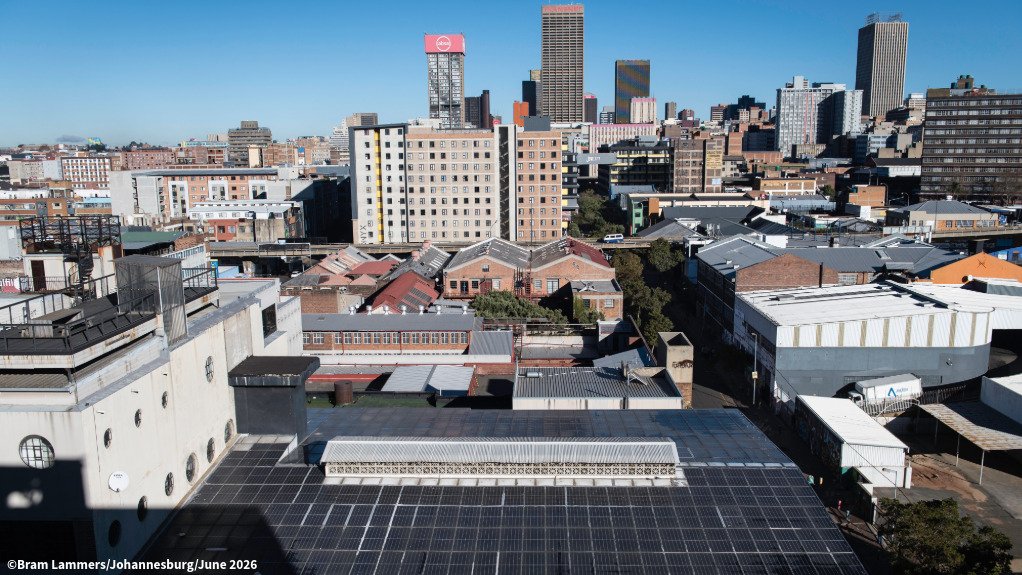

By adopting a cooperative rather than an oppositional stance towards rooftop solar, Gauteng municipalities in particular have an immediate opportunity to reduce the cost of their bulk purchases of electricity, a new report shows.
This cost saving could be amplified materially through the introduction of incentives to scale up installations and by leveraging leased battery energy storage systems (BESS).
Published by the Public Affairs Research Institute (PARI), the report shows that Johannesburg, Ekurhuleni and Tshwane accounted for over half of the more than 2 260 MW of rooftop solar installed by December 2024.
This installed base represents a potential source of cost reduction that could be accessed relatively quickly and easily, as most residential installations produce ‘excess’ electricity on average over a 12-month period, which is curtailed because it has nowhere to go.
This excess electricity, the report states, is potentially available to municipalities at a rate almost half that which is currently paid to Eskom through the Megaflex tariff.
However, PARI views the real opportunity as being one whereby municipalities encourage rooftop solar owners to increase the size of these installations, and sell their excess electricity to the municipality at a discount to the Megaflex tariff. This cheap electricity could then be stored in leased BESS systems for dispatch during the morning and evening peaks.
“Under a scenario of a 20% increase in installation size by commercial and industrial sites and a 50% increase in installation size on residential sites, the combined annual savings for Johannesburg, Ekurhuleni and Tshwane would be almost R2.5-billion per annum – an amount almost equal to the current combined annual capex budgets of those three municipalities,” PARI lead author Tracy Ledger and joint researcher Clyde Mallinson, of Sizana Consulting, calculate.
The potential value of this infrastructure would be forfeited, however, should municipalities continue implementing policies that are hostile to the owners of rooftop systems.
“The current approach of forcing installation owners onto more expensive tariff structures – to incur additional system compliance costs and to carry the full cost of new meters – against a backdrop of rapidly increasing electricity tariffs and the availability of substitute energy sources such as gas, is almost certain to drive much higher rates of grid defection,” the report warns.
Grid defection is described as the “worst outcome”, as municipalities lose both customers and access to cheap power-producing infrastructure that has been paid for and is being maintained by third-parties.
“Municipalities need to adopt a more cooperative approach towards rooftop solar owners, rather than the current oppositional approach common in many municipalities which is based on the fundamentally flawed assumption that rooftop solar is the main reason for current financial problems.”
Using Johannesburg as a case study, the authors calculate electricity losses, in the form of technical and illegal connections, to be almost five times higher than the 772 000 MWh of yearly self-generation; a portion of which is most likely consumed during City Power’s ongoing unplanned outages, which remain high despite waning loadshedding.
“This is the real reason why City Power is in serious financial trouble,” the report asserts, while noting that households have also responded to surging electricity tariffs by installing gas geysers and cookers and by self-limiting consumption.
“Municipalities need to create a situation where rooftop solar owners are happy to enter into a sales agreement with the municipality and to increase the size of their installations.
“This will not happen under the current municipal view of these entities as the opposition.”
The authors, thus, recommend that municipalities shift their approach to one which recognises the potential to diversify their bulk purchases, which account for more than 85% of total municipal electricity revenue, to the cheaper source offered by rooftop installations.
Securing such lower-cost renewables sources would also be far simpler than seeking to enter into long-term and complex power purchase agreements with independent power producers.
“Municipalities need to create a situation where rooftop solar PV owners are happy to enter into a sales agreement with the municipality and to increase the size of their installations,” the authors argue.
It also highlights the results of a recent survey in Johannesburg which found that 40% of respondents who owned rooftop solar would consider feeding their surplus power back into the grid at a zero tariff. This in return for not having to migrate to a time of use tariff with a large monthly fixed charge, of the order of R1 500 before any consumption.
“However, this kind of cooperative approach is unlikely to materialise at scale, unless municipalities adopt a different approach and supporting incentives are in place.”
EMAIL THIS ARTICLE SAVE THIS ARTICLE ARTICLE ENQUIRY FEEDBACK
To subscribe email subscriptions@creamermedia.co.za or click here
To advertise email advertising@creamermedia.co.za or click here


