





South Africa could grow by at least 3% and create 2.4-million more jobs by 2030 relative to 2025 if it doubles down on catalytic reforms, but it must act with renewed urgency if it is to convert rising confidence into “economic lift-off”, research organisation the Bureau for Economic Research (BER) asserts.
In its ‘Scenarios for the South African economy: 2026 – 2030’ report, the BER says South Africa’s growth prospects have perked up as structural reforms are starting to take hold, noting, however, that improved sentiment has yet to translate into the fixed investment needed to spur a rapid recovery.
Instead, the BER says, growth remains fragile and the country highly vulnerable to economic shocks, such as those caused by the current war in the Middle East.
“As a small, open economy, South Africa cannot control the external environment, but it must focus on building resilience and tackling its own internal challenges by undertaking a series of urgent domestic interventions to reinvigorate the economy.”
The BER argues that South Africa faces a set of crucial choices.
The political and policy decisions it makes now will determine whether growth collapses back to 0.5% a year or soars to 3% a year and more over the medium term; whether poverty eases or deepens; whether the fiscal position stabilises or deteriorates; and whether the balance of power tilts towards "the reformers or the populists".
To understand both the costs of inaction and the benefits that could flow from timely action, the BER at Stellenbosch University has modelled three scenarios using a similar core econometric model as the National Treasury and the South African Reserve Bank.
This follows a structured process of engagement with over 60 senior business leaders, government officials and academics.
The BER’s scenarios are themed according to well-known birds – the Hadeda, in which the status quo prevails; the Marabou Stork, in which South Africa slides towards becoming a failed State; and the African Fish Eagle, in which growth soars to 3% or more.
THE HADEDA SCENARIO
The Hadeda is a noisy, low-flying bird – just like the South African economy, says the BER.
In this baseline scenario, the BER says South Africa avoids renewed deterioration, but the deeper constraints that have mired it in a low-growth trap remain unaddressed, and the economy continues to bump along the bottom.
While the Government of National Unity (GNU) holds together, coalition complexity and weak State capacity limit its ability to translate reform intent into delivery.
There is incremental progress, but implementation is uneven and slow; criminal-justice reform advances only gradually; and the broader State machinery continues to struggle, constraining growth, says the BER.
The organisation explains that the upshot is that the upward cyclical momentum South Africa is currently enjoying fails to translate into permanent, structural change, capping the growth rate below 2%.
“This is not enough to materially shift South Africa’s unemployment trajectory or deliver fiscal sustainability. The bottom line: this is a scenario of missed opportunity, of stability without progress, and of rising long-term risk.”
THE MARABOU SCENARIO
The Marabou Stork, also known as the undertaker bird, depicts an economy where reform failure leads to institutional decay, where the capital stock is steadily eroded and the foundations for recovery are eaten away by crime and corruption.
The central trigger, says the BER, is a political realignment that results in a GNU that becomes more populist and fails to back the existing reform agenda.
The BER posits that criminal-justice reform stalls, confidence in the rule of law deteriorates and the investment-led recovery that could have followed improved enforcement is stillborn.
It adds that these institutional failures rapidly translate into tighter financial conditions as investor sentiment sours and risk premia rise, reinforcing the country’s low-growth trap.
Fiscal pressures intensify as weak growth and rising debt-service costs prevent consolidation, causing debt to climb to unsustainable levels, it notes.
The BER argues that in this scenario South Africa is not simply growing slowly – it is losing the productive base required to grow at all, leading to a repeat of the decade of 2009 to 2019.
It notes that growth drifts down toward 0.5% over the medium term and remains depressed below that over the longer term.
“Poverty and unemployment rise, per capita income declines and the country’s politics become even more fractured.
“The bottom line: this scenario represents a political-economic rupture with lasting damage to prosperity and social cohesion.”
THE AFRICAN FISH EAGLE
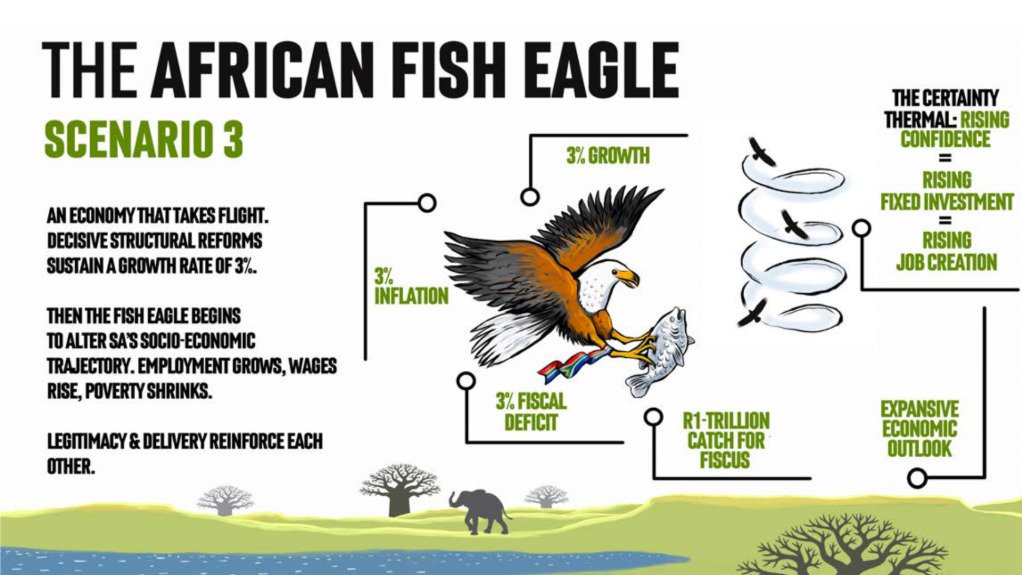
Meanwhile, the high-road scenario sets out what South Africa could look like if it could achieve 3% growth, a 3% budget deficit and 3% inflation within three years.
At a minimum, the BER explains that it would mean the creation of 2.4-million more jobs by 2030 than the economy produced in 2025.
This is about one-million more jobs in total than under the Hadeda scenario.
“Importantly, it’s a story of implementation, not new plans.
“South Africa successfully uses the current political window to fix the basics and rapidly deliver on its reform agenda, supported by a step-change in execution driven by Operation Vulindlela and the normalisation of public-private partnerships.”
The BER notes that this is complemented by a sustained confidence dividend arising from a visible enforcement of the rule of law.
It explains that these gains feed directly into better financial conditions and investor confidence improves.
It notes that the upshot is a sustained fixed-investment upswing which lifts South Africa’s growth potential, pushing it onto a higher, self-reinforcing path.
“The Fish Eagle rises not because conditions are perfect, but because a cyclical recovery is converted into a permanent lift through sustained investment, institutional reform and capital deepening.
“The bottom line: this scenario fundamentally alters South Africa’s prospects.”
The BER says rising growth and employment, falling poverty and political stability reinforce one another in a virtuous cycle that makes the country an attractive investment destination once again.
“In the end, the difference between the Hadeda, the Marabou and the Fish Eagle is South Africa’s ability to deliver on its own reforms,” explains Roy Havemann, who heads the BER’s Impumelelo Growth Lab.
“The binding constraint is domestic: whether the country can build its capital stock, restore the rule of law, maintain credible institutions, and connect to the world economy through a cost-effective national logistics system that boosts exports.”
SUGGESTED ACTIONS
While the BER’s baseline forecast is for economic growth to average only about 1.7% over the longer term, it firmly believes growth of 3% is possible if the structural reforms being undertaken under Operation Vulindlela are accelerated, deepened and supported.
At the same time, the organisation emphasises that the obstacles companies and citizens cite every day must be addressed, noting that these key areas include endemic crime and corruption, energy and water insecurity, collapsing logistics and failing municipalities.
To help boost confidence and growth, the BER has identified ten catalytic interventions across five broad areas: criminal justice reform, public sector reform, procurement reform, budget reform and State-owned enterprise (SOE) reform.
This includes developing a roadmap to overhaul the entire criminal justice system based on recommendations and revelations from the Zondo and Madlanga Commissions; making the National Prosecuting Authority institutionally independent of the Department of Justice and Constitutional Development and free of political interference; and supporting the South African Revenue Service’s big push to combat the illicit economy.
Additionally, interventions include enacting the Public Sector Amendment Bill to depoliticise the appointment of senior public officials, strengthen accountability, and draw private sector skills into the State; modernising administrative systems and introduce a silence-is-consent rule for all licensing regimes in terms of which approval is deemed granted if the State has not replied after six months; and pursuing big-budget, catalytic, cross-departmental projects, such as fixing the Lebombo border crossing, drawing in private sector skills and funding.
The BER also recommends making cost-effectiveness and greater transparency the priority of procurement law; and targeting savings of R100-billion a year by, among other things, including State agencies and entities in departmental budget votes and subjecting them to spending limits.
In addition, the BER recommends that the sector education and training authorities should be scrapped, the Road Accident Fund shifted to a private insurance model and the Unemployment Insurance Fund curbed from pursuing costly new ventures unrelated to its core mandate.
The BER also argues for appointing of strong, independent and accountable boards to SOEs and hastening the move from integrated monopolies to a model that spurs competition and decentralisation.
“The bird we become is ultimately a function of how well the State and private sector work together to achieve a shared plan to grow South Africa. The window to lock in the Fish Eagle scenario is open, but narrow. Implementation speed, not policy intent, will determine which scenario prevails,” Havemann concludes.
EMAIL THIS ARTICLE SAVE THIS ARTICLE ARTICLE ENQUIRY FEEDBACK
To subscribe email subscriptions@creamermedia.co.za or click here
To advertise email advertising@creamermedia.co.za or click here


