





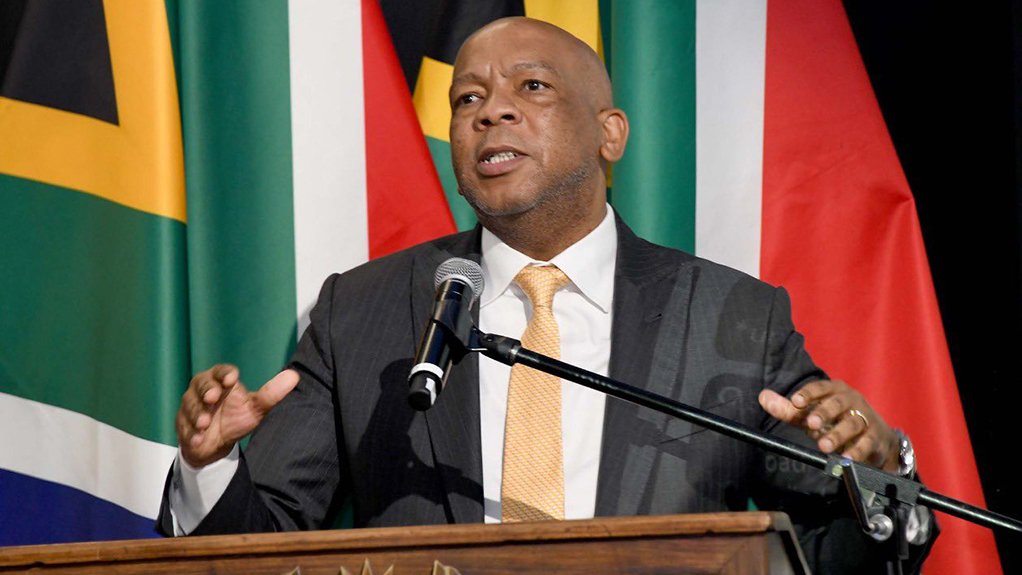
Electricity and Energy Minister Dr Kgosientsho Ramokgopa reports that his department will publish a “sequenced” implementation roadmap for the South African Wholesale Electricity Market (SAWEM) so as to address prevailing uncertainty over the transition to a competitive market structure.
In his Budget Vote address on Tuesday, the Minister said the SAWEM would introduce clearer price signals, improve dispatch efficiency, allocate balancing responsibilities, improve transparency and reduce long-term reliance on the single buyer model.
However, he said the market should be “sequenced with sensitivity” and announced that the Department of Electricity and Energy was finalising a SAWEM implementation roadmap, without providing a timeframe for its launch.
The target launch date of April 1 for the SAWEM itself was not met, and is currently scheduled for the third quarter of the year, with the regulator still to deliberate on the market code.
“The roadmap will set out regulatory milestone, readiness, gates, governance, controls, pricing, alignment, vesting and settlement arrangements and the transition towards the Transmission System Operator (TSO).
“The market will not be built on uncertainty. It will be built on rules, oversight and readiness and public interest,” Ramokgopa averred.
He also reaffirmed the central role of the State in the future market design, arguing that it did not represent a “retreat” but rather transforming the electricity market so that the State could “govern a more complex system with better instruments”.
“The State will therefore continue to plan, it will continue to regulate, it will continue to protect the poor, it will continue to ensure that system security is not compromised [and] it will continue to act to ensure that the market design must serve national development objectives.”
His address comes amid greater electricity supply stability with South Africa expecting to achieve 365 days without loadshedding on May 18.
Nevertheless, a number of market reforms remain outstanding, including the creation of an independent State-owned TSO that owns and controls the transmission assets that have hitherto been held by Eskom and which currently fall under the National Transmission Company South Africa, which is a wholly-owned Eskom subsidiary.
Speaking separately Saul Musker, who is director of strategy and delivery support in the Office of the Presidency, said the Eskom Restructuring Task Team established by President Cyril Ramaphosa following his State of the Nation Address was “very hard at work to establish a fully independent TSO with ownership and control of transmission assets and to remove conflicts of interest”.
Musker also listed several other reform priorities during an EE Business Intelligence webinar that took place ahead of the Budget Vote, including: finalising trading rules, systems and prices to enable a competitive market; reforming the tariff regime to support the introduction of the market and sector unbundling; expanding and strengthening the transmission network; and supporting municipal distributors to make the transition to a reformed electricity sector.
DISTRIBUTION ROADMAP & PRICING POLICY
In his address, Ramokgopa confirmed that distribution sector transformation and the electricity pricing policy would receive urgent attention during the current financial year.
He said the department planned to publish an electricity distribution industry roadmap and was processing changes to the electricity pricing policy, which would be taken to Cabinet for approval before being released for public consultation.
“This process will provide a revised framework for tariff setting, cost reflectivity, wholesale pricing, use-of-system charges, time-of-use pricing, subsidy separation, municipal cost-of-supply enforcement and social protection.”
Other areas of focus of the 2026/27 financial year included stress-testing the Integrated Resource Plan assumptions against actual supply and demand conditions to make it a “living” document; finalising a 20-year outlook for the coal fleet that took account of retirements and opportunities for repowering and repurposing; confronting the impending gas supply cliff in a way that also supported renewables integration and industrial competitiveness; accelerating grid roll-out; and continuing with preparations for a nuclear procurement programme.
Describing the Budget Vote as a statement of execution, the Minister said that while the department’s budget for the year was R6-billion, its role was to unlock a larger R2-trillion investment pipeline in new generation, transmission and distribution investments.
To act as a “catalyst” for such investments he said the department would finalise its institutional design, fill vacant posts, and strengthen its strategic programme management office to support delivery.
EMAIL THIS ARTICLE SAVE THIS ARTICLE ARTICLE ENQUIRY FEEDBACK
To subscribe email subscriptions@creamermedia.co.za or click here
To advertise email advertising@creamermedia.co.za or click here


