





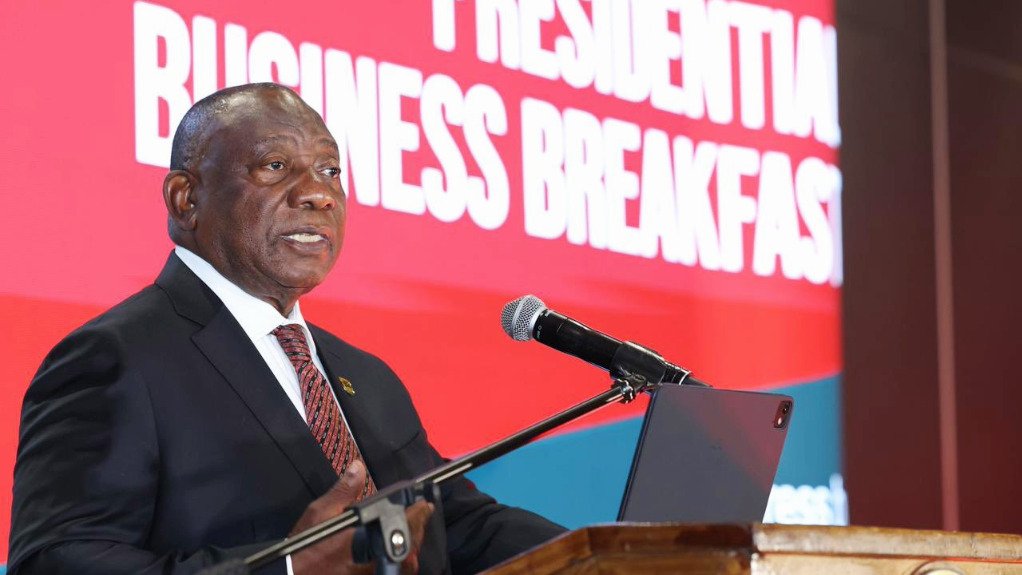
President Cyril Ramaphosa has reiterated the importance of the creation of a fully independent, State-owned transmission company to the development of a competitive electricity market where there is fair access to all market participants.
Speaking to the Steel and Engineering Federation of Southern Africa (Seifsa) following his recent endorsement of the Phase I report of the Eskom Restructuring Task Team, which confirmed the feasibility of establishing a Transmission System Operator (TSO) with grid assets, the President outlined three objectives for Phase II.
These included minimising financial, operational and fiscal risk; strengthening energy security; and contributing to reducing the cost of electricity.
“We will undertake this restructuring carefully and responsibly. We will safeguard the financial sustainability of Eskom. We will protect energy security. And we will ensure that workers are treated fairly,” Ramaphosa said.
No direct reference was made to the National Union of Mineworkers’ threat of legal action against the unbundling, or to remarks by Eskom chairperson Mteto Nyati raising questions about the timing of the asset transfer to the TSO, as well as potential financial risks associated with transferring assets valued at R110-billion from an entity that had major debt obligations.
Instead, Ramaphosa noted that countries across the world had restructured their electricity industries to introduce competition while maintaining public ownership of critical infrastructure.
“South Africa can do the same,” he averred, indicating during a later question and answer session that he was “in a hurry to have these reforms bedded down”.
“We need to inject growth into the economy. We cannot have a situation where jobs continue to be lost whilst we are waiting to stabilise the reforms. The reforms will underpin precisely the growth and the job creation that we want to see.”
AFFORDABILITY IN FOCUS
Ramaphosa also linked the restructuring of the electricity supply industry to the goals of addressing electricity affordability and stimulating industrialisation.
With loadshedding under control, the next phase of electricity reform would focus on reducing the cost of electricity, he said, while acknowledging that electricity prices had become an existential risk to some industries.
“Competition between generators, combined with expanded transmission capacity and continued investment in new generation, must ultimately produce a more efficient electricity system and put downward pressure on the cost of power.”
Ramaphosa also argued that the energy transition should become an industrial transition, highlighting in particular the potential manufacturing spin-offs from the build-out of 14 500-km of new transmission infrastructure.
“Nowhere is the industrial opportunity more immediate than in the expansion of our electricity transmission network,” he said, indicating that the roll-out would require everything from fabricated steel and cables to transformers, insulators and switchgear.
“And behind every one of these products are factories, workers, engineers, artisans and suppliers. This should become one of the great industrial projects of our generation.”
INFRASTRUCTURE & INDUSTRIALISATION
Likewise, Ramaphosa argued that the larger R1-trillion infrastructure drive should be viewed as both a construction and industrialisation opportunity.
However, he also said that localisation should not become a licence for inefficiency or excessive prices.
Responding to questions about whether South Africa’s manufacturers were receiving adequate protection and support, the President argued in favour of a balanced trade policy that protected domestic producers against unfair competition, while ensuring that downstream manufacturers could access competitively priced inputs.
“The work being undertaken by the International Trade Administration Commission on steel tariffs and rebates is intended to achieve precisely this balance,” he said, while describing the emergence of a competitive and sustainable steel industry as a national priority.
Seifsa president Mervyn Naidoo also highlighted the industrialisation potential of the infrastructure programme, but said that deliberate policy interventions would be required if the programme was to stimulate manufacturing and job creation.
“We accept the fact that as an industry we’ve got to be competitive … and that we can’t rely on protectionism. But equally so, I think we need policies that support general investment and strategic investment based on long-term commitments and demand,” Naidoo said.
Ramaphosa acknowledged the need to improve the coordination and publication of the infrastructure pipeline so that companies could see what government, State-owned enterprises and other public institutions intended to procure over an extended time horizon.
“A manufacturer deciding whether to invest hundreds of millions of rand in a transformer factory, cable plant or fabrication facility needs confidence that there will be an order book.”
EMAIL THIS ARTICLE SAVE THIS ARTICLE ARTICLE ENQUIRY FEEDBACK
To subscribe email subscriptions@creamermedia.co.za or click here
To advertise email advertising@creamermedia.co.za or click here


