





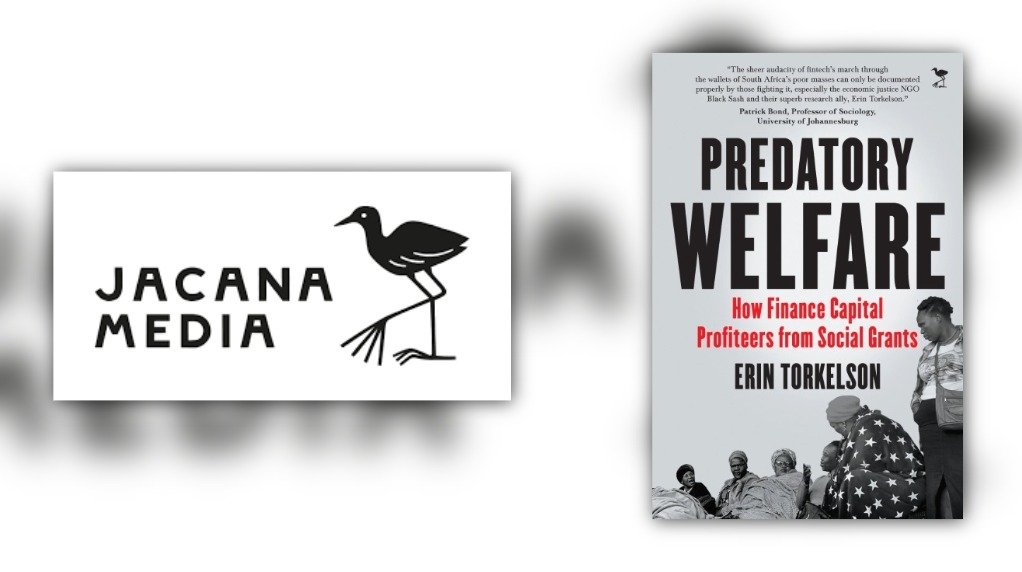
In this heartbreakingly gripping tell-all, South Africa’s public social grants system and private finance capital clash in what ultimately ends in the exploitation of poor black South Africans trapped in a cycle of debt.
‘Twenty-six cents. That was all that was left in Lerato’s bank account when she went to collect her daughter’s child support grant (CSG) at the Site B Community Hall in Khayelitsha on October 3, 2016. Instead of cash, Lerato clutched a receipt as if her life depended on it. This slip of paper was the only thing that offered some explanation as to why she hadn’t received a cash transfer payment for her daughter that month…’
Predatory Welfare explores how social welfare distributed in the form of cash transfers shapes inequality in contemporary South Africa. In this narrative style work, Erin Torkelson follows individual stories and tells how a government-sponsored, flagship anti-poverty programme became entangled with predatory finance.
Drawing on seven years of immersive fieldwork in South Africa — from grant payment queues and grocery stores to Parliament and the Constitutional Court — Torkelson details how grant beneficiaries, who are most often black women, are manipulated by lenders into leveraging their grants for loans, funeral policies, airtime deductions and similar products pushing them into cycles of debt.
This book argues that social grants cannot be understood as neutral or purely benevolent and that welfare requires far more than cash alone.
The personal accounts of grant beneficiaries combined with Torkelson’s academic and on the ground experiential knowledge present the readers with the intricate inequalities and injustices present in the welfare grant system that leave an already vulnerable population exposed to financial profiteers and predators. A timely and urgent intervention, Predatory Welfare asks readers to reconsider what real economic justice looks like — and what it will take to achieve it.
‘When I sat down next to Lerato, she pushed her receipt into my hand, asking me to attend to its contents. The technician should have handed Lerato R350 – the amount of one child support grant. But, since his machine reported that her account was nearly empty, she was turned away with nothing. Her receipt stated that at 8:54 a.m. R350 was deposited in her account. At the same time, a nearly identical sum of money was removed from her account as “deductions” for airtime, electricity, a funeral policy, a loan repayment, and bank fees.’
ABOUT THE AUTHOR
Erin Torkelson is a Senior Lecturer in the Department of Geography at the University of the Western Cape and holds a doctorate in geography from the University of California, Berkeley. As a scholar and an activist, her work sits at the intersection of political economy, critical development studies, critical race theory, feminist kinship studies and science & technology studies. She has published academic pieces in World Development, Society and Space, and the Journal of Southern African Studies. Her popular articles have appeared in Counterpunch, Znet, GroundUp, The Daily Maverick and the Mail & Guardian. She has also ventured into documentary film for The Cutting Edge on SABC1.
She works with the Black Sash, Open Secrets, and the Institute for Economic Justice on the South African social grant system and has presented her research to the Constitutional Court-appointed Panel of Experts, the National Credit Regulator, the South African Social Security Agency and the Department of Social Development.
'Predatory Welfare: How Finance Capital Profiteers from Social Grants' is published by Jacana Media
EMAIL THIS ARTICLE SAVE THIS ARTICLE ARTICLE ENQUIRY FEEDBACK
To subscribe email subscriptions@creamermedia.co.za or click here
To advertise email advertising@creamermedia.co.za or click here


