





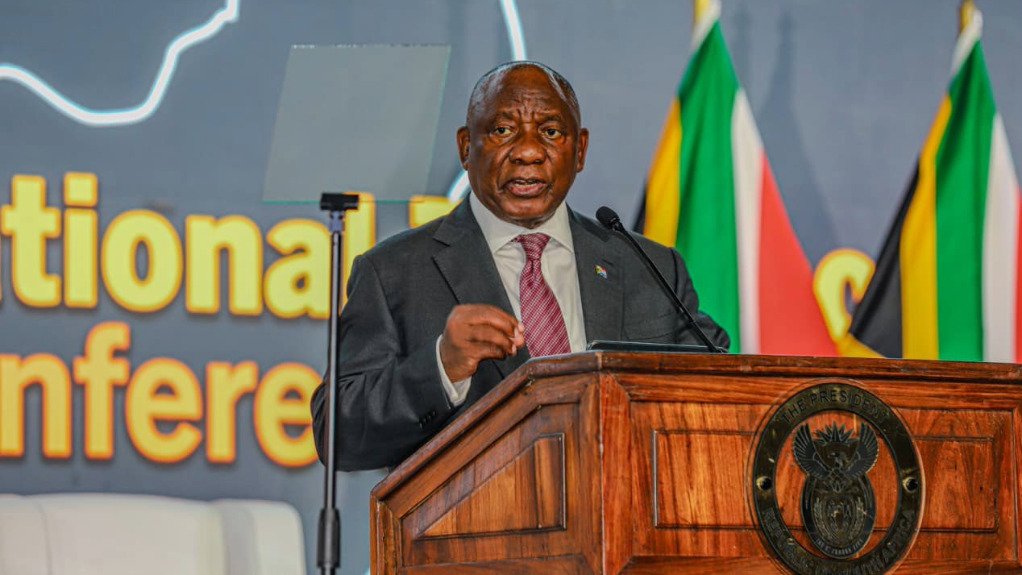
President Cyril Ramaphosa has proposed the establishment of a permanent ‘transport council’ to bring together government and the private sector across all the transport modes of land, air and sea.
He made the call at the inaugural National Transport Conference, which is currently under way in Midrand, arguing that the council should be modelled on the country’s experience with the energy council.
“Just as collaboration transformed our energy response, cross-sector collaboration of this kind will enable further stabilisation and inclusive growth in transport,” Ramaphosa said.
He acknowledged ongoing criticism of his establishment of task teams and committees to address various crises, including a National Logistics Crisis Committee (NLCC), which was set up to address problems on the country’s rail and port networks.
However, he argued that these structures were proving effective, highlighting in particular the progress that had been made in stabilising South Africa’s electricity system.
“Just as collaboration transformed our energy response, cross-sector collaboration of this kind will enable further stabilisation and inclusive growth in transport.”
He also noted the progress made under the NLCC, pointing to “breakthrough projects” on the coal and iron-ore corridors that had improved operational performance.
“Let us seize this moment and place transport at the centre of our country’s growth path,” the President said, while making the case for a new council.
Transport Minister Barbara Creecy confirmed that the proposal would be discussed during the three-day conference, which is being attended by some 750 delegates drawn from across the transport sector.
“We must work together to reform and develop our system in line with major technological and environmental changes.
“Accordingly, we see this conference as an opportunity to grow a sector-wide approach, based on common understanding and to unite on common platforms that build a future we can all share and support,” Creecy added.
PRIVATE PARTICIPATION
Ramaphosa also used his address to highlight the importance government was giving to logistics reform to support economic recovery and higher growth, including reforms aimed at bringing in new investment from private operators.
“Through the establishment of the Transnet Rail Infrastructure Manager, open access to the rail network has become a reality.
“To date, train slots covering 24-million tonnes a year have been conditionally awarded to 11 train operating companies. We expect the first private operator to commence operations in April 2027.”
Private participation was linked to both meeting the goal of moving 250-million tonnes of freight by rail by 2029 and shifting of rail-friendly freight back on to the railways network, with about 69% of freight currently being transported by road.
“This places immense strain on our road network and contributes to poor road safety,” the President said, also referring to the economic cost of inefficient freight logistics, currently estimated at R750-million a day.
“We have launched a new request for information to attract private investment in rapid regional rail, rolling stock and depot modernisation,” Ramaphosa added, again insisting that high-speed rail should be developed between Johannesburg and Musina and Johannesburg and Ethekwini.
EMAIL THIS ARTICLE SAVE THIS ARTICLE ARTICLE ENQUIRY FEEDBACK
To subscribe email subscriptions@creamermedia.co.za or click here
To advertise email advertising@creamermedia.co.za or click here


