





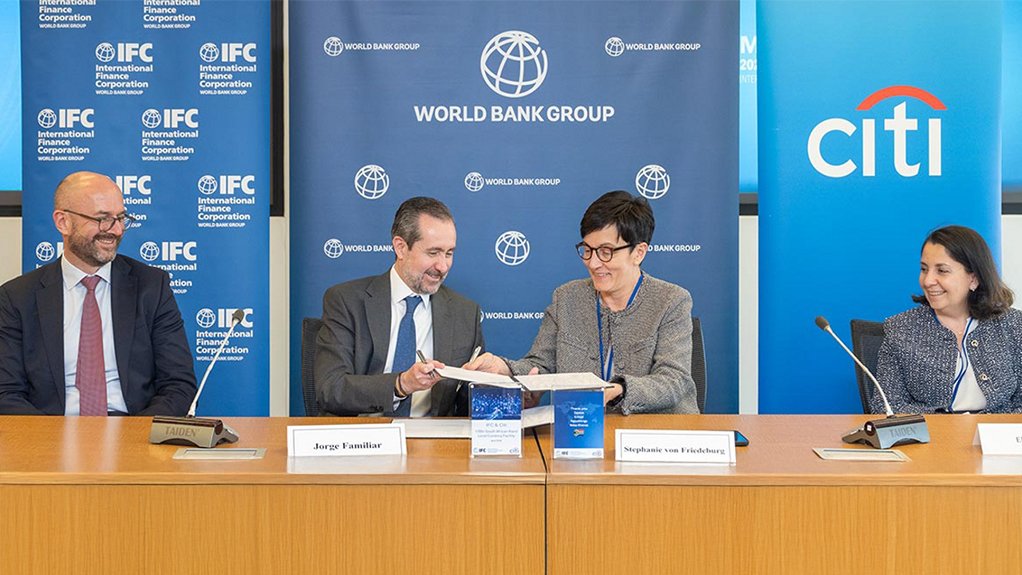

Development finance institution (DFI) the International Finance Corporation (IFC), which is part of global finance organisation the World Bank, has signed a R1.6-billion borrowing facility with financial services firm Citi that will expand the IFC’s ability to provide local currency financing in South Africa.
This facility adds to the World Bank Group's suite of local currency financing instruments and strengthens its capacity to support private sector development.
The facility has supported the IFC's anchor investment into the Cape Water outcome-based bond issued by South Africa's FirstRand Bank, which is the first outcome bond issued by a commercial bank globally, the World Bank says.
Currency volatility remains one of the most important priorities for private sector development in emerging markets. Deep and liquid capital markets are essential to ensuring access to local currency financing for development priorities. By supporting new instruments in local capital markets, the World Bank Group contributes to the further deepening of those markets, it notes.
“Local currency financing and capital markets development in emerging and developing markets are critical priorities for the World Bank Group,” says World Bank Group VP and treasurer Jorge Familiar.
“This facility is another example of what our partnerships with the private sector can deliver – from outcome bonds to local currency solutions – in support of long-term finance for job creation.”
Over the past decade, the IFC has committed more than $33-billion in local currency financing across 71 local currencies.
Further, this new facility builds on a similar one established in Kenyan shilling that the IFC and Citi signed in 2024. The two institutions plan to continue replicating the facility across additional countries.
“This facility deepens our partnership with the World Bank Group,” says Citi Public Sector Group global head Stephanie von Friedeburg.
“Following our Kenyan shilling transaction, this first South African rand facility reflects a model that can be replicated throughout emerging markets. It adds to the toolkit for DFIs and supports local currency financing where it is needed most.”
EMAIL THIS ARTICLE SAVE THIS ARTICLE ARTICLE ENQUIRY FEEDBACK
To subscribe email subscriptions@creamermedia.co.za or click here
To advertise email advertising@creamermedia.co.za or click here


