





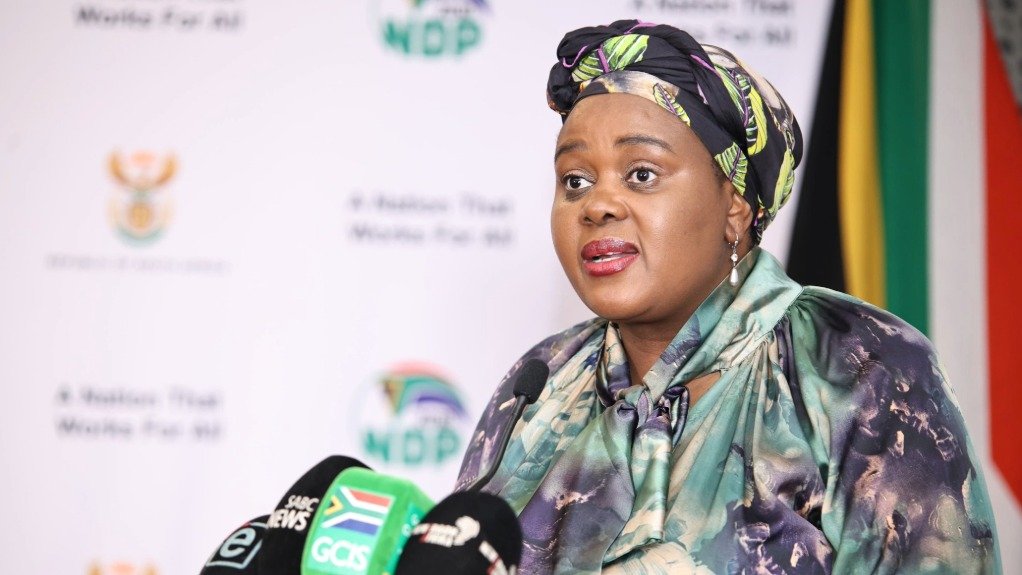

Minister of Justice and Constitutional Development Mmamoloko Kubayi has announced a sweeping, multidisciplinary national strategy to reclaim thousands of hijacked buildings across South Africa's major metropolitan areas and drastically tighten the country's immigration and border controls.
Speaking on Tuesday, Kubayi revealed, as head of the Inter-Ministerial Committee (IMC) on migration management, that between April and July 2026, border authorities intercepted more than 4 200 undocumented foreign nationals trying to cross into South Africa outside formal ports of entry, primarily along the northern corridor bordering Zimbabwe, followed by Lesotho and Mozambique.
The crackdown has triggered a massive spike in expulsions.
Between June 14 and August 20, a staggering 86 596 foreign nationals were processed for deportation and repatriation.
Statistics show that 90% of these individuals entered the country illegally, with 95% classified as border jumpers.
Citizens of Malawi formed the largest demographic of deportees, followed closely by Zimbabwean and Mozambican nationals.
To manage localised humanitarian bottlenecks, government is monitoring the ongoing situation in Che Guevara road, in Durban. The United Nations High Commissioner for Refugees (UNHCR) is currently assisting the group there with voluntary community reintegration, while compiling information for those wishing to relocate to the Lindela Holding Facility as a temporary alternative.
Government’s multidisciplinary offensive has also targeted local businesses. Law enforcement has conducted over 350 000 industrial inspections across Gauteng, KwaZulu-Natal, and the Western Cape, exposing widespread labour and health violations, specifically the deliberate hiring of undocumented workers.
To sustain this pressure, government has initiated a massive enforcement expansion, finalising the deployment of 6 317 labour inspectors, which includes 4 017 newly recruited interns and 2 300 experienced inspectors reassigned to joint blitz operations.
Furthermore, the Department of Home Affairs (DHA) has advertised 301 Immigration Inspector posts, with recruitment wrapping up by the end of September.
So far, police have registered 205 building-related criminal cases, resulting in 354 arrests and 123 cases already placed on the court roll.
Looking forward, Kubayi emphasised that the DHA is actively drafting a brand-new legal framework to overhaul citizenship and immigration systems.
Backed by technological upgrades like the newly launched Electronic Travel Authorisation initiative, the reforms aim to eradicate fraud, secure the borders, and transition South Africa into a modern, lawful migration system.
ILLEGAL OCCUPATION
Kubayi also announced that the IMC has finalised a consolidated blueprint to address the "menacing challenge" of bad and illegally occupied structures, which have rapidly turned into inner-city havens for dangerous crime syndicates, human trafficking and drug distribution networks.
A comprehensive IMC report drawing on data from the eight metropolitan municipalities, Johannesburg, Tshwane, eThekwini, Ekurhuleni, Nelson Mandela Bay, Mangaung, Buffalo City, and Cape Town, has identified about 2 400 non-compliant buildings.
While the report confirmed that metros already possess the requisite by-laws and enforcement structures to act, a severe legal and financial bottleneck has paralysed executions.
Under Constitutional Court rulings, municipalities cannot lawfully evict illegal occupants without providing funded temporary emergency accommodation, a resource most metros lack.
During an IMC meeting with metro mayors last Wednesday, mayors raised alarms over bleeding municipal revenues owing to unpaid rates, alongside dangerous, unauthorised water and energy consumption.
To counter inner-city decay and stop syndicates, some of which are reportedly orchestrating operations from inside prisons, mayors urged government to help repurpose vacant spaces into student housing and affordable rentals.
To break the execution deadlock, Kubayi announced that the Department of Human Settlements will spearhead a national funding model dedicated exclusively to temporary emergency accommodation.
She noted that the Department of Justice and Constitutional Development will formally prioritise hijacked-building litigations within the Magistrates' and High Courts.
The Department of Cooperative Governance will deploy a single national definition and reporting template to systematically measure and track the crisis.
"Our law enforcement is geared towards dealing with the criminal syndicates that operate these buildings through illegal collection of rent and other forms of abuse suffered by illegal occupiers," Kubayi warned.
EMAIL THIS ARTICLE SAVE THIS ARTICLE ARTICLE ENQUIRY FEEDBACK
To subscribe email subscriptions@creamermedia.co.za or click here
To advertise email advertising@creamermedia.co.za or click here


