





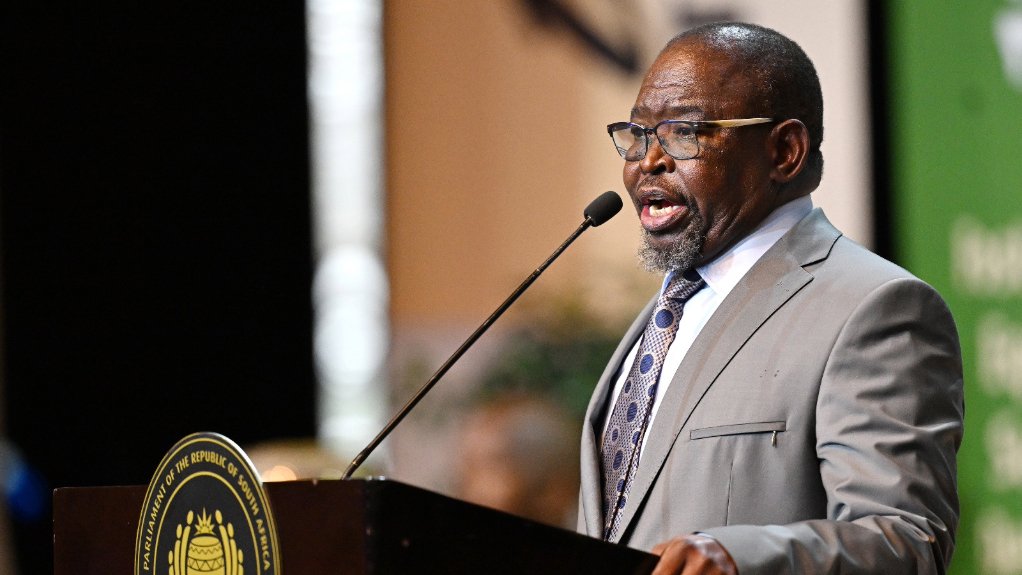

During the sixth South Africa Investment Conference on March 31, Finance Minister Enoch Godongwana and Public Works and Infrastructure Minister Dean Macpherson spoke about how the government was supporting greater investment by private-sector players in the economy.
Godongwana emphasised that a reliance on monopolies in an economy meant that, if there was a problem with a monopoly, the entire sector it served was challenged.
An example of this was the challenges experienced with State-owned power utility Eskom, which led to years of loadshedding.
“Critical to fixing this shortage of power to the grid was to get as many generators as possible online, which also means that there is a more competitive generation market in place.
“A similar arrangement was in place for logistics under State-owned Transnet and a similar problem caught up with us, and led to the entire sector, including mining, facing challenges. This inability of companies to export efficiently also impacted on the State's revenue,” Godongwana said.
South Africa aimed to create competitive rail transport and energy generation systems and wanted to move with speed, he said.
“It is in our interests to implement these [structural economic] reforms because research indicates that, if we are able to move with speed, we can boost our economic growth from 1.6% or 1.8% to about 3.5% a year.”
South Africa also aimed to reform the capacity of the State, particularly at municipal level. This was because, if municipal regulatory frameworks and business environments made it difficult for businesses to operate, then this environment had to be changed to make it easy to do business.
South Africa was looking at creating a regulatory framework to facilitate this, Godongwana said.
Macpherson similarly said the Department of Public Works and Infrastructure's (DPWI's) role was to prepare infrastructure projects for investment, and pointed out that about 80% of infrastructure projects failed to attract investment because they had not been properly prepared.
The Presidency-led infrastructure project support agency Infrastructure South Africa (ISA) is undertaking a trial project with four local municipalities in South Africa.
There were crises of infrastructure maintenance and development in many local governments, with about R100-billion of infrastructure grants returned to the National Treasury each year, representing missed opportunities, Macpherson said.
Under this pilot initiative, ISA and the DPWI partner with and support local governments by providing them with technical capacity to undertake infrastructure projects.
The pilot project identified about R8-billion worth of projects across the four municipalities for electricity reticulation, roads and water projects that could significantly improve their ability to deliver services, he said.
“[Entertainment and leisure company] Sun International had approached the DPWI about losing clients that could not fly in owing to the poor state of the Pilanesberg Airport [in the North West province].
“The provincial government had tried to implement a project to renew the airport three times without success. We therefore asked ISA to provide support and relaunch this project. We are working to see a public-private partnership take place to redevelop the airport,” said Macpherson.
In a subsequent panel discussion, Eskom Group CE Dan Marokane said that, for South Africa to benefit from its renewable-energy resources that were distant from load centres and to realise the investment opportunities, it must build about 14 400 km of transmission and distribution infrastructure within nine years at a cost of about R440-billion.
To facilitate this, South Africa is piloting independent transmission projects (ITPs); initially for 1 200 km of transmission lines in the first phase.
This initiative was supported by the Treasury-led credit guarantee vehicle (CGV), which was backed by global finance institution the World Bank. This CGV shielded the government's balance sheet while enabling investment in grid infrastructure, said Marokane.
Eskom and government were already in conversation about the quantum of grid that it would aim to build under the next phase of the ITP, considering the build rate achieved to date and where it could facilitate connection to existing generation capacity, he said.
“It is important that we build quickly to 2030 to capitalise on new capacity from renewables, hence the participation of the private sector in the ITPs. It is important to make these opportunities available and enable broader participation in this space,” said Marokane.
South Africa's rich renewable-energy resources and associated battery energy storage presented considerable green industrialisation opportunities, but it had to craft collaboration arrangements in line with its and regional industrial and value chain development goals, Presidential Climate Commission (PCC) executive director Dorah Modise said.
The energy transition has to be connected to industrial development such that, before South Africa starts deploying energy storage systems, it has to consider what industrial nodes will be part of the value chains and how to support and position initiatives to generate competitive and sustainable opportunities.
Grid expansion is necessary for unlocking green industrial development and renewable-energy-based industries.
“As part of our work at the PCC, we collaborate with [development finance institution] the Development Bank of Southern Africa to prepare projects under the CGV to unlock opportunities and ensure opportunities for participation by local businesses.
“The policy signals are in place. The investors are here. We need to work on building a pipeline of investment-ready projects and clear policy pathways for investors to invest in infrastructure projects and in the development of industrial value chains,” she said.
“Investment opportunities are not found; they are built. The right investment in infrastructure and energy can create the jobs required for the future,” said multilateral finance institution Africa Finance Corporation president and CEO Samaila Zubairu.
Infrastructure was financed mainly in local currency and domestic capital pools were needed to finance infrastructure projects. Many countries in Asia had successfully financed infrastructure development using their own finances, he said.
“To progress, Africa must finance its development. We must build the future we want now and not wait for it to happen, which means we must finance it and use domestic capital pools that are available.”
In certain mature markets, such as Australia and Canada, infrastructure was often owned by pension funds, and Africa could look to replicate this. However, this would require creating instruments to ensure the funds could flow into infrastructure projects, he said.
South Africa's structural reforms had started to translate into execution, delivery and accountability, with South Africa starting over the past two years to reverse the capital outflows of the prior decade, said JSE CEO Valdene Reddy.
As South Africa improved its position and attracted more investors, it would create greater momentum and a longer-term trajectory towards growth, she said.
EMAIL THIS ARTICLE SAVE THIS ARTICLE ARTICLE ENQUIRY FEEDBACK
To subscribe email subscriptions@creamermedia.co.za or click here
To advertise email advertising@creamermedia.co.za or click here


