





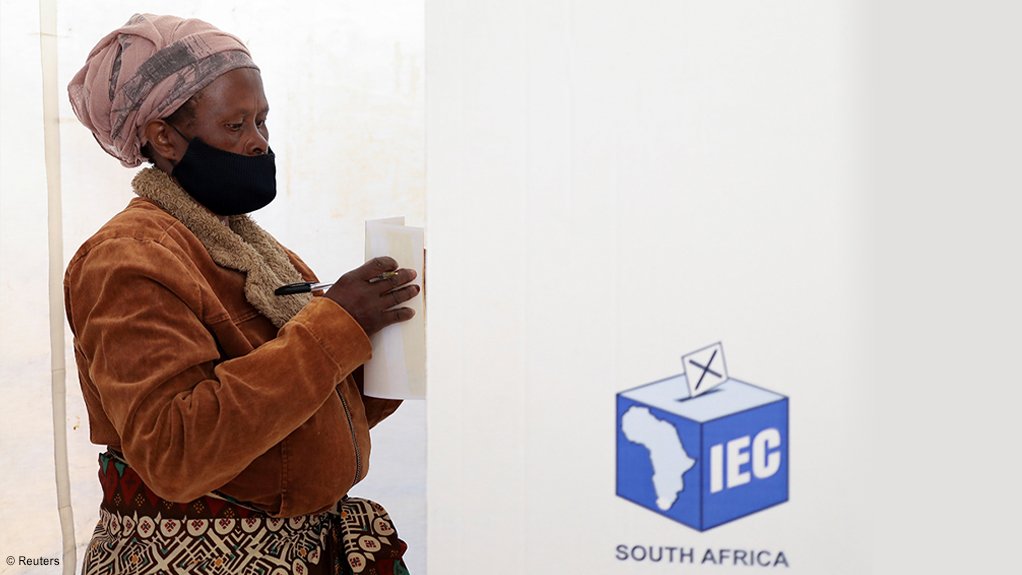
As South Africa heads to the 2026 municipal polls, political parties and brands face a crowded battlefield where names, logos, slogans and campaign material can become the subject of urgent legal disputes, writes Alude Xuba.
South Africa goes to the polls on 4 November 2026. With over 500 registered political parties, an IEC-launched campaign already underway, and brands whose identities stretch across every billboard, broadcast, and social media feed in the country, the intersection of intellectual property law and electoral competition has never been more crowded, or more consequential.
For political parties, intellectual property (IP) risks are immediate and often underestimated. In the same way, election season can turn commercial businesses’ most valuable assets, that is, their names, logos, and goodwill, into contested terrain without warning. Understanding how IP law operates in this environment is the difference between a protected campaign and an urgent interdict.
Many political parties assume that registering with the IEC is enough to protect their brand identity. The Electoral Commission Act 51 of 1996 prevents other parties from registering a confusingly similar name or symbol, and the Electoral Act 73 of 1998 prohibits the plagiarism of registered symbols between parties. However, these provisions only operate within the IEC registration system and only against fellow registered parties. They do not protect against misuse by third parties, supporters, media or opposition campaigns, and they do not cover marks that are similar but not identical. Trade mark registration under the Trade Marks Act 194 of 1993 fills that gap. Section 34(1)(b) protects against similar marks where a likelihood of confusion exists. Section 34(1)(c) goes further, protecting well-known marks against dilution even without direct competition or confusion, where use takes unfair advantage of, or is detrimental to, the mark’s distinctive character. Remedies under section 34(3) include urgent interdicts, removal of the infringing mark, and damages. In Adidas AG v Pepkor Retail Limited [2013] ZASCA 3, the Supreme Court of Appeal confirmed that these protections are robust and real. A global sportswear brand recently used the same principles to compel a political movement to remove its three-stripe mark from campaign materials.
Campaign materials such as posters, jingles, videos, social media graphics and manifestos are protected by the Copyright Act 98 of 1978 from the moment they are created. The problem for political parties is one of ownership. Section 21(1)(a) of the Act vests copyright in the author as first owner, while section 22(1) requires any transfer of copyright to be in writing and signed by the assignor. Without a formal written assignment agreement, copyright in a party’s campaign logo or jingle belongs to the designer or composer, not the party that paid for it. This is not a theoretical risk. If a relationship with a creative contractor breaks down mid-campaign, the party may find itself unable to use its own visual identity. Addressing this requires nothing more than a properly drafted commissioning agreement, but it must be in place before the creative work begins.
On the other side of copyright sits fair dealing. Section 12(1)(c) of the Copyright Act permits criticism or review of a work, provided the source is credited. Opposition parties and commentators who parody campaign materials are entitled to rely on this provision, but the protection is not unlimited, as the following section makes clear.
According to the common law of delict, passing off protects goodwill and established reputation against misrepresentation, rather than the trade mark itself. Where a trade mark is not registered, political parties and commercial brands can therefore protect their goodwill and reputation through the common law delict of passing off. This test, established in Capital Estate and General Agencies (Pty) Ltd v Holiday Inns Inc 1977 (2) SA 916 (A), requires proof of an established reputation, a misrepresentation likely to deceive the public, and resulting damage. In an electoral context where a newer party adopts branding strikingly similar to an established one, or where campaign materials falsely imply endorsement by a well-known brand, all three elements may be satisfied. The constitutional dimension arises where parody and satire are invoked as a defence. Section 16(1) of the Constitution protects political expression, and the Constitutional Court in Laugh It Off Promotions CC v South African Breweries International (Finance) BV t/a Sabmark International and Another [2005] ZACC 7; 2006 (1) SA 144 (CC) confirmed that parodic use of a trade mark can constitute protected expression. However, the protection is not automatic. The Court held that a trade mark owner must demonstrate a likelihood of substantial economic detriment. That courts must conduct a context-sensitive balancing of expressive freedom and IP rights. A campaign poster that parodies a competitor’s logo may be constitutionally protected. One that causes real harm to a commercial brand’s economic value almost certainly is not.
The 2026 elections are not just a political contest but also an eye-opener on how IP works in this context. Parties that go into the campaign period without registered trademarks, properly assigned copyright in their creative materials, and legal advice on the limits of political expression are taking entirely avoidable risks. Commercial businesses whose brands operate in a visible public space face the same exposure from the other direction. Intellectual property disputes during elections move at the speed of an urgent application.
Alude Xuba is an admitted attorney of the High Court of South Africa and the founder and principal attorney of the boutique business and IP law firm Xuba & Associates Attorneys Inc. He has a keen interest in corporate and commercial law, intellectual property law, artificial intelligence, and litigation.
EMAIL THIS ARTICLE SAVE THIS ARTICLE ARTICLE ENQUIRY FEEDBACK
To subscribe email subscriptions@creamermedia.co.za or click here
To advertise email advertising@creamermedia.co.za or click here


