






South Africa’s economy remains highly concentrated, with about one-third to one-half of 228 economic subsectors still ranked as highly or moderately concentrated; however, there are positive trends of reducing concentration in most sectors of the economy.
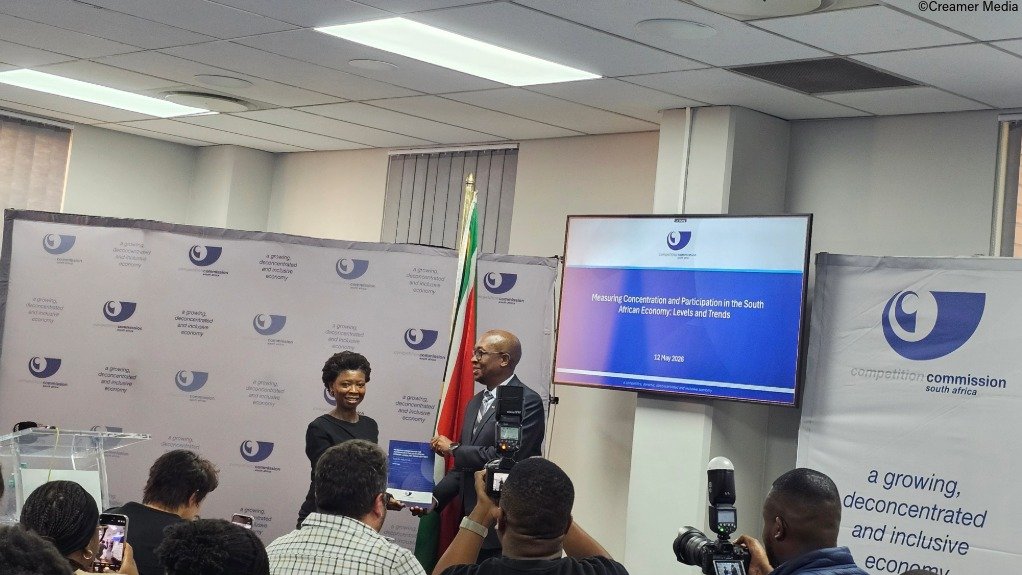
This is according to the Competition Commission of South Africa’s second ‘Economy Concentration Tracker’ report, which Competition Commissioner Doris Tshepe handed over to Trade, Industry and Competition Minister Parks Tau in Pretoria on May 12.
Some of the factors driving the deconcentration are enforcement; disruptive digital entry enabling positive results for deconcentrating sectors over time; and regulatory reforms to develop competitors helping to reduce concentration in other markets, Competition Commission acting deputy commissioner James Hodge explained, presenting key findings of the report at the handover.
However, of concern was that micro, small and medium-sized enterprises (MSMEs) still had a limited presence in the economy and were struggling to scale, with this threatening the inclusiveness of the economy, he warned.
The most highly concentrated subsectors are in manufacturing, mining, energy and transport.
Notably, electricity and transport include State-owned enterprises that were previously legislated monopolies, alongside concentrated private markets in gas, sea transport and waste management.
In mining, concentration is particularly pronounced in energy-related commodities, including oil, gas, coal and iron-ore.
Since 2017, the share of highly concentrated subsectors has declined by five percentage points, with ten subsectors shifting from “high” to “moderate” concentration.
Reductions in concentration are evident in many subsectors, with about two-thirds of highly concentrated and nearly three-quarters of moderately concentrated markets recording a decline in the concentration measure.
The biggest progress in addressing concentration issues is in markets characterised by multiple competing large firms or an oligopoly market.
By contrast, single-firm dominant markets show far less movement, often linked to exclusionary conduct.
The report, the second iteration following the publication of the first in 2021, explains how high and persistent concentration can undermine growth, job creation and competitiveness.
The study sets out concentration levels and trends and assesses the participation of MSMEs in the economy.
The analysis draws on data from about 450 000 tax-registered firms during 2017 to 2021.
The report also highlights barriers that limit MSME entry, participation and expansion. MSME participation in the economy remains low by global standards and was set back by Covid-19, and as a result, there is a high degree of inequality in the distribution of firm turnovers.
MSMEs make up 97% of tax-registered firms, but account for just 22% of total turnover. This is well below the Organisation for Economic Cooperation and Development average of about 50%.
Most firms were micro-sized (about 80%) or small (about 13%). Medium-sized firms made up only about 4%, reflecting a “missing middle” in the economy, Hodge explained.
He emphasised that addressing barriers for these was critical for inclusive growth, as MSMEs were significant employers, accounting for 44% of employment and being twice as employment-intensive as large firms.
TOOL FOR CHANGE
The study is designed to aid prioritisation and decision-making across government to address concentration and promote participation.
Aligned to the country’s Medium-Term Development Plan objective of de-concentrating the economy, the commission will use the report to sharpen its focus on priority markets.
The findings will support enforcement and market inquiries by assisting with prioritising sub-sectors for investigation.
They will also inform merger control to prevent further concentration.
Moreover, they will guide engagements with policymakers and regulators on reforms that can open markets. These insights will support the commission’s enforcement and policy work.
They also complement broader government initiatives to foster inclusive growth and job creation.
Speaking at the handover, Tau pointed out that the concentration was a legacy of the Apartheid system, that did not automatically end when democracy was implemented. This was supported by the report, which reflected on the legacy of Apartheid-era market structures, among other factors.
The Minister emphasised the need for a concerted effort to mitigate this, with Tshepe calling for an all-of-government approach and the participation of civil society and other organisations and stakeholders.
Hodge called for a dismantling of barriers – both routes to market and regulation – that entrench incumbency and prevent challenger firms from thriving in markets.
Moreover, government policy and competition law should have an increased emphasis on scaling successful entrants, given that this remained the signal largest bottleneck for MSME growth, he stressed.
Regulatory reforms should avoid prioritising monopolies, and instead, break up first as single firm monopolies were more durable than oligopoly markets, Hodge averred.
He also advocated for policy and funding that supportsed disruptive technological entrepreneurs and promoted greater inclusion in new technologies and markets.
EMAIL THIS ARTICLE SAVE THIS ARTICLE ARTICLE ENQUIRY FEEDBACK
To subscribe email subscriptions@creamermedia.co.za or click here
To advertise email advertising@creamermedia.co.za or click here


