





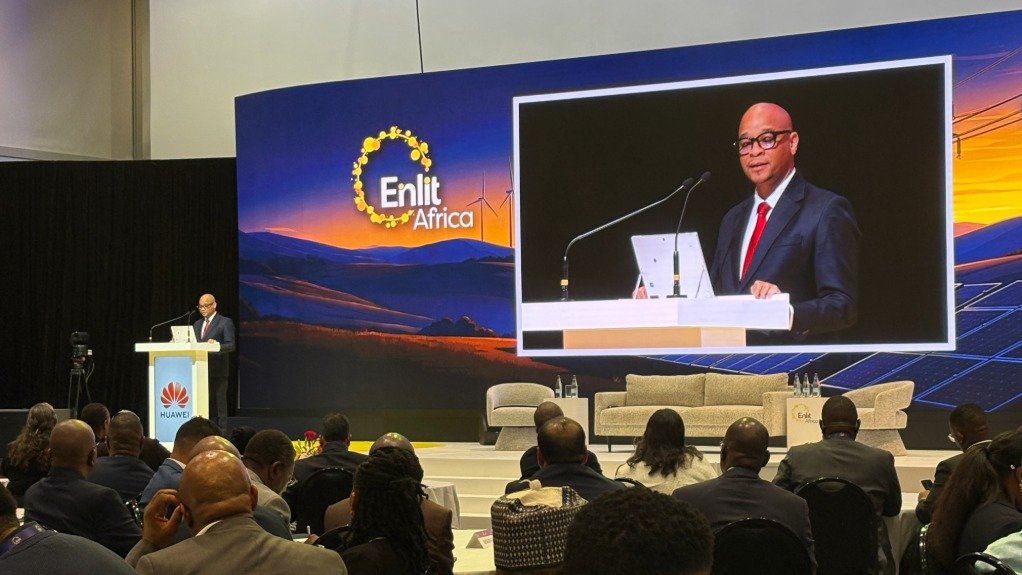
As South Africa this month celebrates 365 days without loadshedding, the Department of Electricity and Energy (DEE) is turning its attention to the challenges of load-reduction, supply security and electricity affordability.
The goal now was to convert Eskom’s one-year achievement into lasting energy security through the addition of new capacity, grid expansion, stronger distribution networks and affordable supply, said DEE energy programmes and projects deputy director-general Thabo Kekana at the opening of Enlit Africa 2026 in Cape Town on Tuesday.
“For many communities electricity insecurity continues through local interruptions, overloaded feeders, illegal connections, vandalism and weak distribution networks.”
Kekana said it was important for every household, clinic, school, business, farm and community to access reliable power supply.
“We may have turned the corner on loadshedding, but load reduction remains a serious expression of distribution failure.”
Kekana said it was the department’s goal to eradicate load reduction by this time next year.
Load reduction is a temporary power outage implemented in targeted areas to prevent electricity networks and transformers from overloading. It is primarily caused by illegal connections, electricity theft and meter tampering, all of which place heavy strain on infrastructure.
“The real goal is reliable, affordable and useable electricity that improves livelihoods, expands opportunities and enables participation,” added Kekana.
“We must, therefore, move from access to availability, and from availability to affordability.
“Affordability means pricing that supports households, sustains municipalities, retains industries, attracts investment and protects the poor.”
Kekana said the DEE was currently advancing its newly compiled electricity pricing policy for Cabinet processing as well as public consultation.
“This policy is to provide a revised framework for tariff-setting, wholesale pricing, use-of-system charges, municipal cost of supply enforcement and social protection.
“We will also review free basic electricity so that the support to vulnerable households is much better and targeted, more consistently implemented, transparently funded and aligned with verified data, smart metering and municipal billing systems,” noted Kekana.
Electricity and Energy Minister Dr Kgosientsho Ramokgopa said earlier this month that the new policy was expected to be made public before the end of May.
Between 2007 and 2023, electricity prices soared by 987%, with inflation up by 150% in the same period, he noted.
EMAIL THIS ARTICLE SAVE THIS ARTICLE ARTICLE ENQUIRY FEEDBACK
To subscribe email subscriptions@creamermedia.co.za or click here
To advertise email advertising@creamermedia.co.za or click here


