





While South Africa’s raw water supply remains in balance with existing demand on a national scale, localised deficits remain – with municipal water services reliability declining sharply and water board debt increasing.
This has resulted in continued worsening water services disruptions, sewage spills and poor water quality in many areas, as highlighted in the most recent release of the Department of Water and Sanitation’s (DWS’s) Green Drop report.
The report shows that there has been an increase in the percentage of municipal wastewater systems in a critical state of performance, from 39% in 2022 to 47% in the 2025.
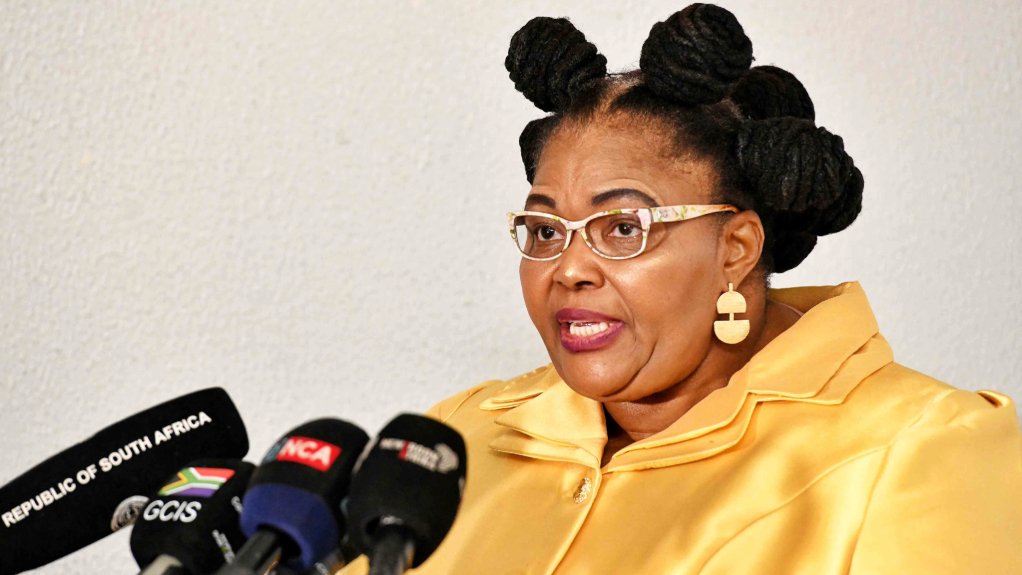
During her Budget debate response on Friday, Water and Sanitation Minister Pemmy Majodina said that overdue debts from municipalities to water boards had also deteriorated.
As at March, overdue debt, excluding current invoices, amounted to R23-billion, while total debt exceeded R27-billion, an increase from R24-billion total debt reported in July 2025.
This is despite ongoing interventions, with water boards increasingly implementing credit control measures, including throttling water supply to non-paying municipalities and attaching municipal bank accounts.
Majodina said she had also led coordinated engagements with premiers, mayors and Cooperative Governance and Traditional Affairs MECs to improve payment compliance, while National Treasury had implemented the withholding of equitable share allocations for the worst non-paying municipalities, which has affected 62 municipalities to date.
Turning to the municipal services decline, Majodina pointed out that while most people now had access to a tap, water often did not come out of the tap or was not safe to drink.
To mitigate the challenge at the reticulation level, President Cyril Ramaphosa’s National Water Action Plan targets reforms to the way in which services are delivered to improve their financial sustainability and to ensure that they are effectively managed by staff with the required competencies.
The action plan focuses on the ring-fencing of revenue from the sale of water, supporting the operation, maintenance, upgrading and long-term sustainability of municipal water services and addressing crime, corruption and sabotage in the water sector.
The DWS will also make increasing use of its water boards and other implementing agents such as the Development Bank of Southern Africa to assist struggling municipalities to implement projects more expeditiously.
The focus of the increased support and intervention will be on the worst performing 107 municipalities in terms of the full 2023 Blue Drop and full 2025 Green Drop reports.
The department is also supporting broader institutional and governance reforms within the water sector, including support for National Treasury’s Metro Trading Service reforms and technical guidance on ring-fencing municipal water services as sustainable trading functions.
“We also support some of the metropolitan municipalities with major strategic infrastructure projects, including the Klipdrift water treatment works in Hammanskraal, in Tshwane, as well as the Welbedacht pipeline in Mangaung,” Majodina said.
Phase 1 of the Welbedacht pipeline was completed in June 2025 at a cost of R585-million, improving water supply reliability to Mangaung. Phase 2, which comprises a 71 km expansion estimated at R1.6-billion, is in advanced planning, with implementation scheduled from 2027 to 2032.
In addition, the DWS initiated a nationwide programme to accelerate access to water services for unserved communities, many of which are in rural areas.
The programme seeks to implement rapid, cost-effective and appropriate interventions such as groundwater development, spring protection and rainwater harvesting, in addition to extensions of existing water supply systems.
Substantial work has been done to identify communities and potential water sources where there is no formal potable water infrastructure or where existing systems are non-functional, with over 2 600 settlements identified.
“We are now packaging a number of projects, prioritising grant funding, mobilising our water boards, the private sector and civil society, including through the Adopt-a-Village approach, to accelerate implementation,” she continued.
In the Eastern Cape, 14 borehole projects are currently under implementation, serving 16 communities, while a further eight spring protection projects are being facilitated in partnership with the Department of Agriculture. In KwaZulu-Natal, 28 boreholes and two spring protection projects are being implemented.
Meanwhile, the DWS has been fully spending its infrastructure grants for municipalities, and has been allocated R12.3-billion from the Regional Bulk Infrastructure Grant (RBIG) and the Water Services Infrastructure Grant (WSIG) in the current financial year.
The RBIG will fund 70 bulk infrastructure projects across all provinces, while WSIG will support 341 projects.
These projects are at various stages of implementation, with 175 planned for completion this financial year.
Grants will also be used to leverage additional investment by unlocking partnerships with the private sector and development institutions.
Majodina further highlighted grant-funded bulk water projects that had been completed in 2025/26, and those that would be completed in the current financial year.
This includes four bulk water schemes, at a cost of R2.24-billion, in the Chris Hani district municipality, Engcobo, Xonxa and Hofmeyr, in the Eastern Cape, with completion expected by June.
Projects that have already been completed in the region include the R15-million Misgund bulk water scheme and the R9-million Sterkspruit water treatment works refurbishment, both of which concluded in March.
In KwaZulu-Natal, Phase 4 of the R1.5-billion Maphumulo bulk water supply scheme is planned to be completed by December 2026, following on the completion of Phase 3 in November 2025.
The R2-billion Loskop regional bulk water supply scheme, in Mpumalanga, is expected to be operational by December, along with the R500-million Gabosch dam.
The R882-million Driekoppies bulk water supply scheme will be completed by June 2027.
Also in Mpumalanga are the R52-million Piet Retief water treatment plant refurbishment and the R234-million Eesterhoek and Ekulindeni bulk water scheme, both of which were completed in March.
The North West’s R351-million Moretele South bulk water supply scheme was completed in March, while the R790-million Mafikeng South bulk water supply scheme and the R845-million Brits water treatment works will be completed by August and September respectively.
The R605-million Greater Mamusa bulk water supply scheme and Phase 2 of the Taung/Naledi bulk water supply scheme will completed by June and the R146-million Ratlou bulk water project is scheduled for completion in July.
In Limpopo, The Phase 1 (24 of 55 villages) reticulation of the R4.8-billion Giyani water project was completed in February, followed by the completion of the R736-million Babanana bulk water pipeline in March.
The Mametja Sekororo bulk water scheme Phase 1 was completed in December 2025.
The R797-million Moutse bulk water supply scheme is planned for completion by October.
Meanwhile, in Gauteng the R759-million Klipdrift water treatment works, in Hammanskraal, is producing the full 50-million litres a day, with minor outstanding work and network preparation work by City of Tshwane completed in May. The full completion of the project is expected in June.
The R1.1-billion George water supply project, in the Western Cape, is on track for completion by October.
EMAIL THIS ARTICLE SAVE THIS ARTICLE ARTICLE ENQUIRY FEEDBACK
To subscribe email subscriptions@creamermedia.co.za or click here
To advertise email advertising@creamermedia.co.za or click here


